
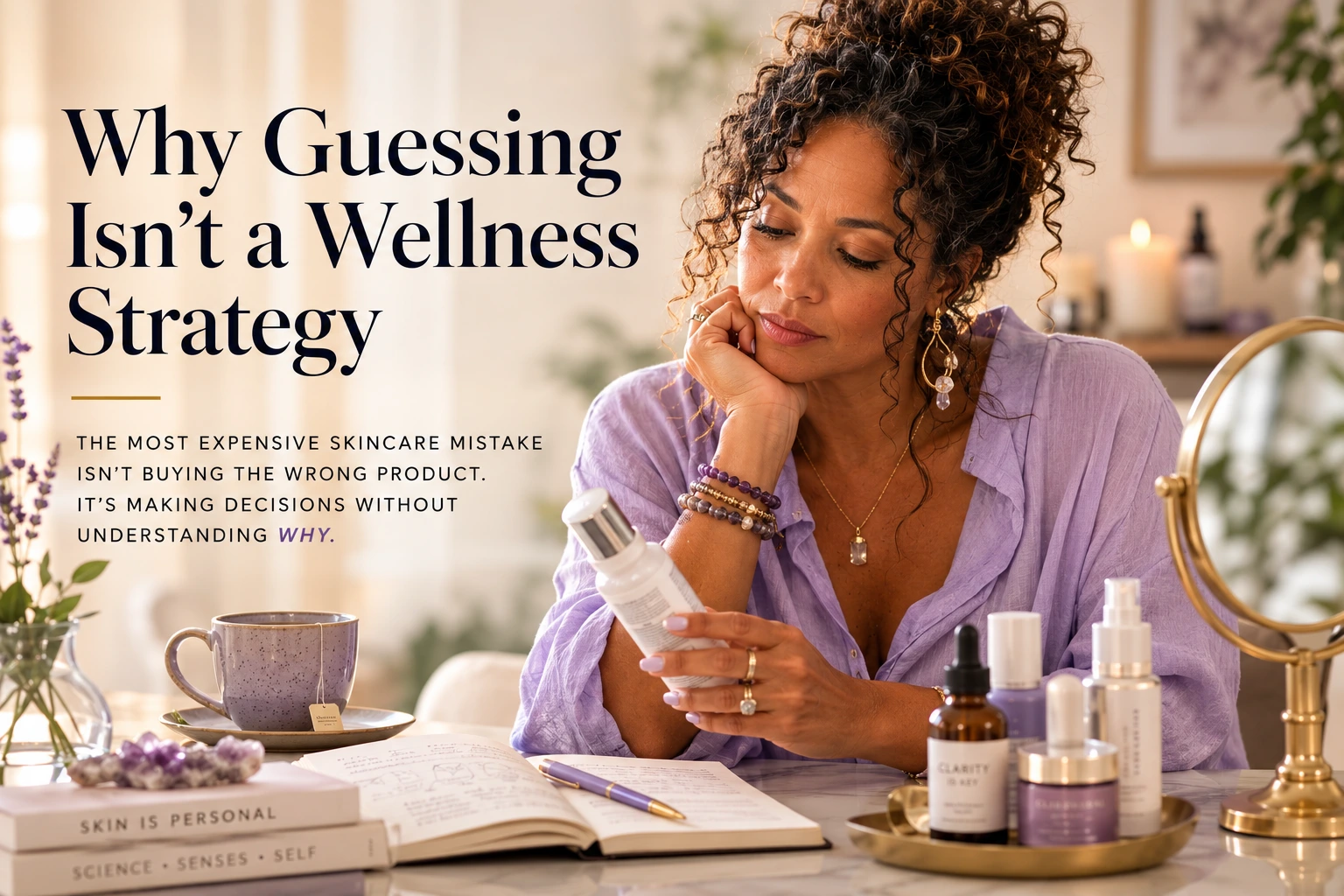
Why Guessing Isn't a Wellness Strategy
Updated: July 2026
Reading Time: 6–7 minutes
The most expensive skincare mistake isn't buying the wrong product. It's making decisions without understanding why.
One of the most surprising things I noticed early in my career had nothing to do with skin.
It was what happened after the facial.
Clients would leave with personalized recommendations based on their skin, their goals, and what I'd observed during the treatment. I'd carefully write everything down, explain why I chose each product, and answer their questions.
Then many would say they were going to shop at a store where they could earn points—or open Amazon—and buy something else.
Not because they didn't trust me.
Because they thought they were making the smarter decision.
The ingredients looked similar.
The reviews were good.
Someone on YouTube said it was "just as good."
At the same time, I was mentoring estheticians who were frustrated because clients weren't purchasing professional products. The conversation almost always centered on retail sales.
Mine didn't.
I wasn't worried about losing a sale.
I was worried about what happened next.
Weeks later, many of those same clients would return disappointed. Their skin hadn't improved. Sometimes it had become more irritated. They'd spent more money trying to fix the problem than they would have by following the original plan.
What struck me wasn't that they had chosen a different product.
It was that they had never really understood why the original recommendation had been made.
That observation changed the way I approach education.
Over the past decade, something else has changed.
The gap between professional skincare and what you can buy online has become much smaller.
That's not necessarily a bad thing.
There are more quality products available today than ever before. Consumers have access to ingredients that once could only be found in a professional treatment room. Artificial intelligence can analyze your skin. Social media can introduce you to ideas you might never have discovered otherwise.
Information has become remarkably accessible.
The challenge is that information without context can be incredibly convincing.
When every product promises hydration, barrier repair, brighter skin, or healthier aging, how do you know which one was actually meant for you?
That's the question I wish more people asked.
Because most people don't waste money on bad products.
They waste money on products that were never the right fit in the first place.
There's a difference.
One unintended consequence of today's beauty industry is that we've trained people to chase ingredients instead of understanding skin.
An ingredient becomes the hero.
Niacinamide.
Retinol.
Vitamin C.
Peptides.
The conversation quickly becomes, "Should I be using this?"
I find myself asking a different question.
Why do you think you need it?
That's not a trick question.
It's an invitation to slow down.
The best ingredient in the world won't solve a problem it was never designed to address.
The goal isn't to own the most talked-about ingredient.
The goal is to understand what your skin is actually asking for.
This is where I believe estheticians have a responsibility that often gets overlooked.
Dermatologists are experts in diagnosing and treating diseases and disorders of the skin. Influencers often excel at introducing new products and trends. Cosmetic chemists create remarkable formulations.
Estheticians occupy a different space.
We study healthy skin.
We learn how skin behaves across seasons, life stages, routines, environments, and everyday habits. We spend hours listening to people's stories while observing their skin over time. We notice patterns that don't always appear in a before-and-after photo.
That's why I believe everyone deserves to have a trusted esthetician on their personal advisory board.
Not because we have all the answers.
Because asking the right questions often leads to better ones.
There's another pattern I've been thinking about lately.
We live in a culture that makes it incredibly easy to disconnect from ourselves.
We're busy.
Distracted.
Constantly consuming information.
Then something changes.
A breakout.
Unexpected pigmentation.
New sensitivity.
A few more hairs in the shower.
We immediately zoom in on the visible problem.
Sometimes we become so focused on fixing one vanity metric that we never stop to ask what else has changed.
How have you been sleeping?
How stressed have you been?
Has your routine changed?
Have your hormones changed?
Are you spending more time outdoors?
Did your medication change?
Have you been caring for everyone except yourself?
Those questions aren't a replacement for science.
They're part of it.
Because skin doesn't exist separately from the person living inside it.
People often ask what they should buy.
I understand why.
It's a simple question.
But after more than twenty years in this profession, I think there's a better one.
Instead of asking,
"Is this product good?"
Try asking,
"Why would this work for me?"
That one word—me—changes the conversation.
It moves us away from popularity and toward personalization.
Away from trends and toward understanding.
Away from guessing and toward informed decisions.
When someone leaves one of my consultations, I don't measure success by whether they purchased what I recommended.
I measure it by something much less tangible.
Do they understand themselves better than when they arrived?
Can they recognize patterns they couldn't see before?
Do they feel more confident making decisions the next time they're standing in that skincare aisle?
Because that's always been my goal.
Not to create people who depend on my recommendations.
To help create people who no longer have to guess.
Continue Your Journey
If this article resonated with you, you may enjoy:
Personalized Care Starts with Understanding
Why Isn't My Skincare Routine Working?
If you're ready to move beyond trial and error, personalized guidance can help you make decisions based on your skin, your lifestyle, and your goals—not someone else's.
Skin Clarity Session offers a personalized assessment to help you better understand what's influencing your skin and what steps make sense for you.
Skin Clarity Experience
Feeling overwhelmed by skincare choices or wondering why your current routine isn't delivering the results you want? The Skin Clarity Experience combines advanced AI-powered skin analysis with profes
Book NowAura Insight explores patterns in your well-being that may be influencing how you feel, helping you reconnect with yourself through guided awareness and practical next steps.
Aura Insight Experience
Sometimes the most meaningful step forward begins with greater awareness. The Aura Insight Experience combines aura imaging with a personalized interpretation to provide meaningful insight into your c
Book NowAbout the Author
Toshiana Baker is a licensed esthetician, educator, and founder of SpaWorx. With more than two decades of experience, she helps people better understand the connection between skin, wellness, and the everyday patterns that influence both. Through education grounded in science, observation, and curiosity, she empowers clients and professionals to make informed decisions with greater confidence—not just follow the latest trend.